
Nonprofit website that services a community. Jewish Family Service of Orange County a case study.
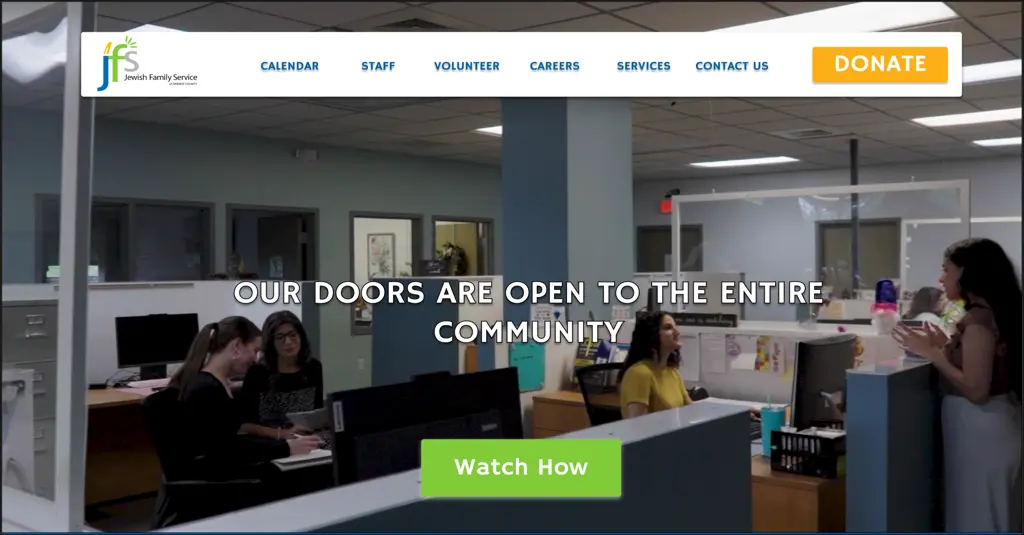
Jewish Family Service of Orange County is a nonprofit that connects all members of the Orange County, NY community and connects them to resources and services that can provide support and comfort. This was an amazing experience. Recently, I have worked with clients wanting a new website while not having a previous one. JFS had a website already and a history of what worked and didn't work for them and their company. While a clean slate is fun to work on, I found their personal experience with owning a website already refreshing. They were very clear on what didn't work, which left me with so much inspiration on how to give them what they needed. It wasn't just enough to give the site a facelift; the site itself would have to allow them to reach out to the community at large.
First, we iterated over the design, creating regular meetings to establish the new look and feel. They needed something modern that inherited its color palette from their logo. As a developer, I usually prefer a darker design to be easier on the eyes; it made more sense for this design to feel open and light. We also decided to highlight a video that was made of them performing their services. In fact, this video did so well explaining their services that I wanted to add it to the hero section. For those who are not in the know, a hero section is the first section you see on a website. Typically at the top of the page. Instead of an image, I wanted the video to be playing. Their home page was designed to grab attention and educate on how JFS of Orange County is able to help you.
After approving the design, it was onto functionality. As mentioned before, I wanted to empower them without them having to worry about breaking the design. As you may know, if you have read my case studies, I tend to use Statamic as a Content Management System (CMS). While there are plenty of choices, I keep returning to this CMS not just from familiarity, but in how it is designed. Not only is it built on Laravel, a PHP framework, but its main focus is on content rather than on design. Which means that I would be able to establish a hierarchy of responsibilities. There would be established roles on how and who was able to do what.
Which leads me to priorities. Often when I'm creating a website, I do triage. Determining what features to create and when to implement them. This was pretty clear; I needed to create an add-on to Statamic that would perform a few functions. First, it would establish who works for the company. Allowing JFS to add a staff member to the staff page. Second, it would allow them to make a staff member into a user. Third, that user could be given a role and a temporary password. Users who were higher in the organization were able to make certain edits, deletions, and view information. This was an important part to get correct the first time.
Next in the priorities was the calendar. The calendar needed to be easily updated from the backend, while also being easily read by users. We opted for a classic calendar look rather than a list of the events. This makes it easier for the primary clientele of JFS to find events. However, on the backend of the website, the staff are able to easily add an event by adding to the events collection. Statamic makes this an easy task. Speaking of Statamic, the way they handle forms makes the creation of both applications easy. JFS would be able to easily review the applications.
Knowing JFS would eventually want to update and edit the site themselves, I created some easy layouts and templates to help format the content without them worrying about breaking the site.
This truly exercised all my skills, and I am excited to build more features for them going into the future.